
The business, by the numbers
Is this a real business, or an expensive hobby?
It is a real business. It is also a seasonal one with a weekday half that most owners never work.
Here is the honest version, from people who still run one or two of these themselves.
Who books you, what a month holds, what owners charge, and what it costs to run.
The market you would be entering
Established, competitive, and not a boom
Short answer: party rental is a real industry with real competitors, and it is steady rather than surging.
IBISWorld puts party supply rental in the United States at $8.5 billion in 2026.
By its figures that market shrank 0.6 percent in 2026, after growing 4.0 percent a year since 2021.
So this is an established business to enter, not a gold rush. Treat anyone selling you a gold rush accordingly.
Your real competition at a birthday party is the bounce house, and it is not going away.
Global Market Insights valued the global bounce house market at $4.2 billion in 2024.
It forecasts $6.2 billion by 2034, growing about 4.1 percent a year. That was published in March 2025.
We went looking for evidence that parents are tiring of bounce houses. We did not find any.
So the case for a gaming theater is not that the alternative is dying. It plainly is not.
The case is that a bounce house is forgotten by Monday. The trailer is what the kids talk about at school.
Those two figures describe an industry. They say nothing about what any one owner earns, and we do not publish earnings.
Sources: IBISWorld, Party Supply Rental in the US, 2026. Global Market Insights, Bounce House Market, March 2025.
Who actually books you
Six kinds of customer, and only one of them is a birthday
Short answer: birthdays fill Saturday. The other five fill the rest of the week.
- Birthday parents.
- Your bread and butter, and almost entirely weekend afternoons. Ages seven to fifteen is the sweet spot, and the booking usually happens two to four weeks out.
- Schools and after-school programs.
- Weekday afternoons, reward days, field days, the end of the school year and PTA fundraisers. They book earlier, pay by invoice and rebook on a schedule.
- Corporate and team events.
- Family days, holiday parties, staff appreciation. Larger budgets, longer lead times and far less price sensitivity than a birthday.
- Churches, camps and youth groups.
- Summer is their peak, which is useful because it is not always yours. Repeat business here is strong once you are known.
- Community and city events.
- Block parties, festivals, National Night Out, grand openings, library and community center programs. Often flat-rate, and often the best advertising you will ever be paid to do.
- Neighborhood word of mouth.
- Every event puts your unit in front of the families who are there. That might be twenty at a birthday party, or fifty at a school day. In this business that is not a marketing channel, it is the marketing channel.
The half of the calendar nobody works
Saturday fills first, then most owners wait six days
Short answer: Monday through Friday is a second business, and almost nobody is competing for it.
Most new owners build their whole plan around Saturday. Saturday fills, and then the trailer sits.
Schools, camps, corporate teams, senior communities and youth groups all book during the week.
They book earlier than parents do. Schools pay by invoice, and they rebook on a schedule.
The owners who do best treat those five days as the real opportunity, because the competition is not there.
What a month can physically hold
Two on a Saturday, three on a good one, four is a long day
Short answer: the ceiling is set by setup, teardown and drive time, not by demand.
Two bookings is an average Saturday. Three is a good one. Four is achievable and it is a long day.
Not every weekend day fills, and you should not plan a business on the assumption that it does.
How many parties an active owner does in a month depends on the owner.
It depends on whether they run it full time, part time, weekends only, or around the holidays.
We do not publish an average, because there is not one worth publishing.
What the seasons do to you
Short answer: spring and early summer are heavy, and December depends on who you know.
Spring and early summer are your busiest stretch. Late summer depends entirely on your climate.
In the hotter markets that is when air conditioning stops being a spec sheet line.
It starts being the reason you get the booking rather than the other guy.
Fall steadies out. December swings on corporate and holiday events rather than birthdays.
Owners with school and corporate relationships have a very different winter from owners without them.
What owners tell us they charge
Owner-reported prices, not ours
Short answer: roughly $449 to $599 for two hours, and your market moves it.
These numbers come from what owners report charging. Your market and your competition move them.
- A two-hour party.
- Two hours is the usual minimum, and you set the price. Owners in the Southeast tell us about $449. On the West Coast, about $549. In the Northeast, about $599.
- Extra hours.
- Typically $99 to $149 an hour depending on the market.
- The weekday events.
- Schools and corporate typically pay the same rates as parties, and schools pay by invoice. If an event needs an extra staff member, owners typically add about $100.
Put your own figures in instead of ours: the calculator on the home page starts empty and uses only the numbers you set.
These are projections based on assumptions you choose, not reported owner results. Premier Gaming Trailers doesn't promise or guarantee any level of income. What a gaming theater business earns depends on your market, your pricing, and how hard you work it.
What it costs to run
Beyond labor, what owners report spending
Short answer: the biggest variable is whether you run it yourself or pay someone to.
These are typical figures owners report. They are not a quote, and your market will move them.
- Generator.
- About $1.00 to $1.50 an hour to run.
- Maintenance.
- About $25 to $35 per 100 hours of use.
- Games.
- About $100 to $200 a month, depending on the owner.
- Storage.
- About $100 to $150 a month. Most owners keep the trailer at a storage facility between events.
- Insurance.
- Yours to arrange and to price locally, and we do not sell or arrange it. Owners typically insure the trailer itself and carry a general liability policy.
- Fuel for the tow vehicle.
- Yours to price locally.
The equipment side is on the three mobile video game trucks, and what one costs is on the cost and financing page.
What it takes to run one
One person, if the trailer is built for it
Short answer: a unit that needs two people to operate costs you a wage at every booking.
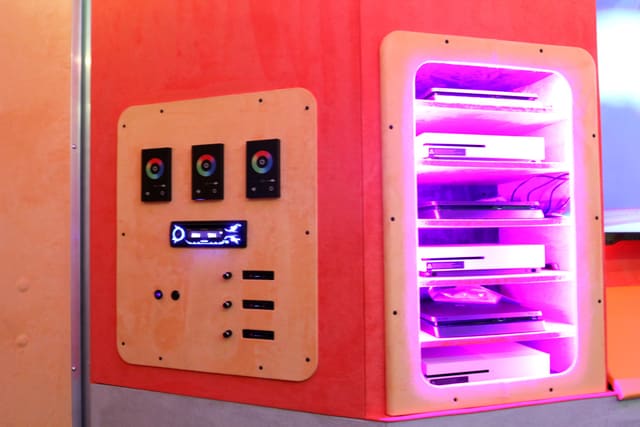
Every console, switch, light and volume control sits in one rack at the front.
You change a game or turn a station down without walking the length of the trailer mid-party.
Over a year of weekends, that difference is the gap between one trailer and two.
Questions buyers ask about the business
Questions buyers ask about the business
Is this a real business or a weekend hobby?
That is your decision, and the trailer works either way. Run it Saturdays only and it is a side business. Work the weekday half as well and it is a full one.
The difference is not the equipment. It is whether you chase schools, camps and corporate work.
How many parties can one gaming theater physically do in a day?
Two is an average Saturday once you account for setup, teardown and drive time between bookings. Three is a good one. Four is a long day and it is achievable, but not every weekend day fills.
What do owners charge for a two-hour party?
It varies enormously by market. Owners tell us roughly $449 in the Southeast, $549 on the West Coast and $599 in the Northeast. Your own market, your competition and your unit's finish all move that.
These are figures owners report to us, not prices we set.
Do I need employees?
Not for the party itself if the trailer is built to be run from one rack at the front. Owners typically add help when they add a second unit, not before.
Is this seasonal?
Birthdays are steadier than most people expect, but the mix shifts. Owners who build school, camp and corporate relationships fill the weekdays and the winter months that pure birthday operators lose.
What happens if a bounce house company undercuts me?
Some will, and the bounce house market is not shrinking. You are not selling floor space by the hour.
You are selling the thing the kids talk about on Monday, and that is a different argument to have with a parent.
How much can it earn?
We do not publish earnings, because we do not know your market or how hard you will work it.
The calculator on the home page takes your own events, your own price and your own margin, and calculates nothing until all three are yours.
These are projections based on assumptions you choose, not reported owner results. Premier Gaming Trailers doesn't promise or guarantee any level of income. What a gaming theater business earns depends on your market, your pricing, and how hard you work it.
Want to sanity-check your own numbers?
Call with your market and your prices
We will tell you what looks realistic and what does not.
We still run one or two of these ourselves, depending on the season, so it is not theory.